
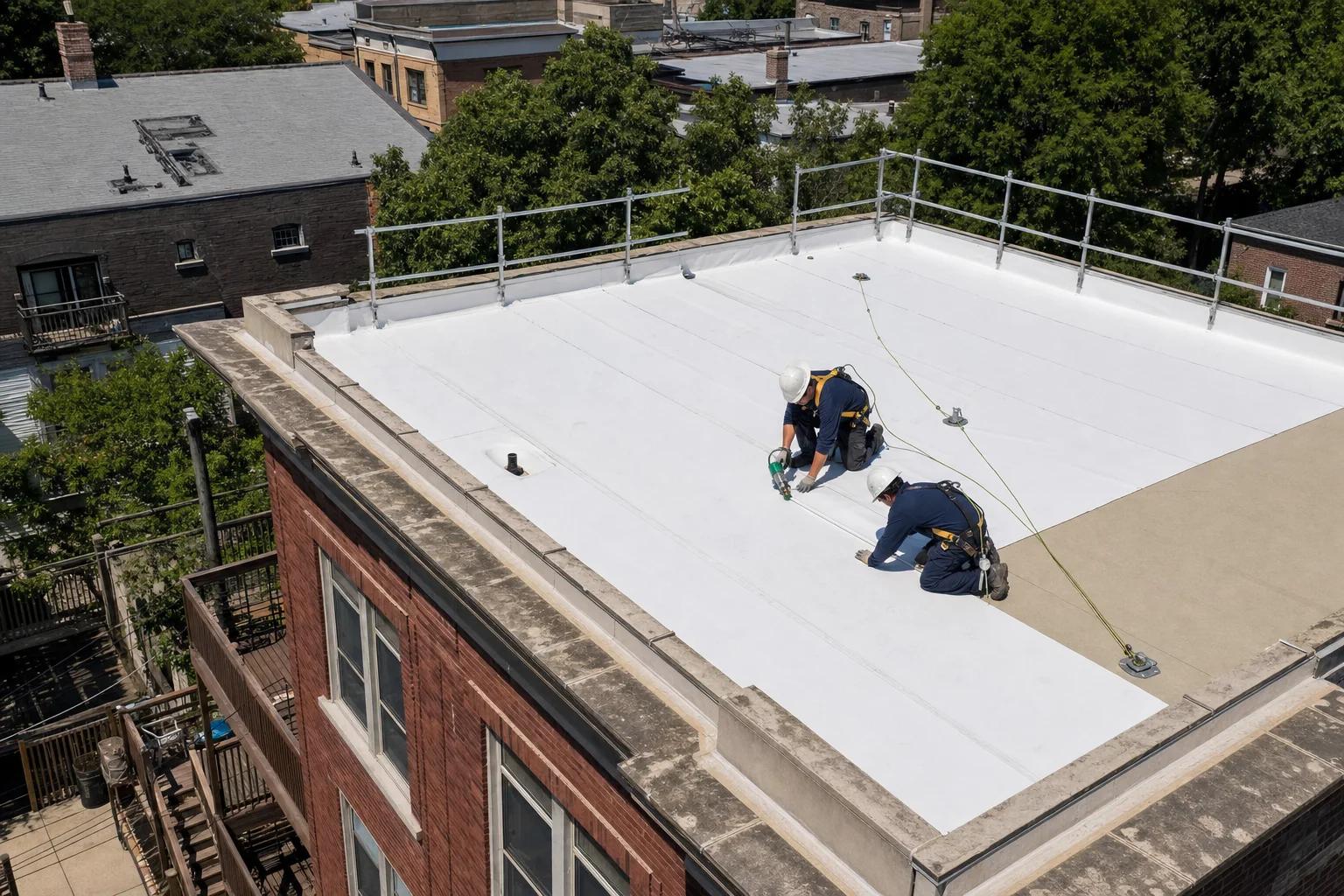
In Illinois, anyone paid to do roofing work must hold a state roofing license, which the Department of Financial and Professional Regulation (IDFPR) oversees. Look up the license before you sign, get a written contract that shows the license number, and ask your city whether the job needs a permit. Permit rules vary from town to town.
The state roofing license
- It is unlawful to act as a roofing contractor in Illinois without a license.
- A limited license covers residential properties of 8 units or less. An unlimited license also covers commercial and industrial properties.
- The license name and number must appear on contracts, bids, commercial vehicles and advertising.
- No license is needed to roof your own property or to do roofing for free.
How to check a roofing license
- Get the license number from the contract, bid or truck.
- Search it in IDFPR's License Look Up, which is updated daily.
- Confirm the name matches the company you are hiring and that the license type fits your property.
What the contract must include
The Illinois Home Repair and Remodeling Act covers repair and remodeling work on homes of up to six units. It does not create a license. It requires a signed written contract before work starts on larger jobs, and it requires the contractor to give you the pamphlet 'Home Repair: Know Your Consumer Rights.' If the contract has an arbitration clause or a jury waiver, it must be disclosed, and you accept or reject it separately. The Act also sets minimum liability and property damage insurance for contractors.
Permits differ by town
- Rockford requires a permit for all roofing work.
- Naperville does not require a permit for an asphalt shingle roof on a single-family home when the existing sheathing stays in place. Metal, wood, slate or sealed membrane roofing does need a permit.
- Chicago requires a permit before most construction and repair work. Its online Express Permit Program covers most types of repair work.
- State law lets cities regulate roofing through permits, fees and inspections, so always ask the local building office.
When roof damage tends to happen
The Illinois State Climatologist reports that 63% of the state's tornadoes occur from April through June. Average hail days range from about 3.3 a year in the southwest to fewer than 1.8 in the northeast. In March 2026, a state-record 6.6-inch hailstone fell near Kankakee.
Sources (10)
- Illinois General Assembly (225 ILCS 335, Illinois Roofing Industry Licensing Act) · checked 2026-09-24
- Illinois Department of Financial and Professional Regulation · checked 2026-09-24
- Illinois Department of Financial and Professional Regulation · checked 2026-09-24
- Illinois General Assembly (815 ILCS 513, Home Repair and Remodeling Act) · checked 2026-09-24
- City of Rockford · checked 2026-09-24
- City of Naperville · checked 2026-09-24
- City of Chicago Department of Buildings · checked 2026-09-24
- Illinois State Climatologist, Illinois State Water Survey · checked 2026-09-24
- Illinois State Climatologist, Illinois State Water Survey · checked 2026-09-24
- Illinois State Climatologist, Illinois State Water Survey · checked 2026-09-24