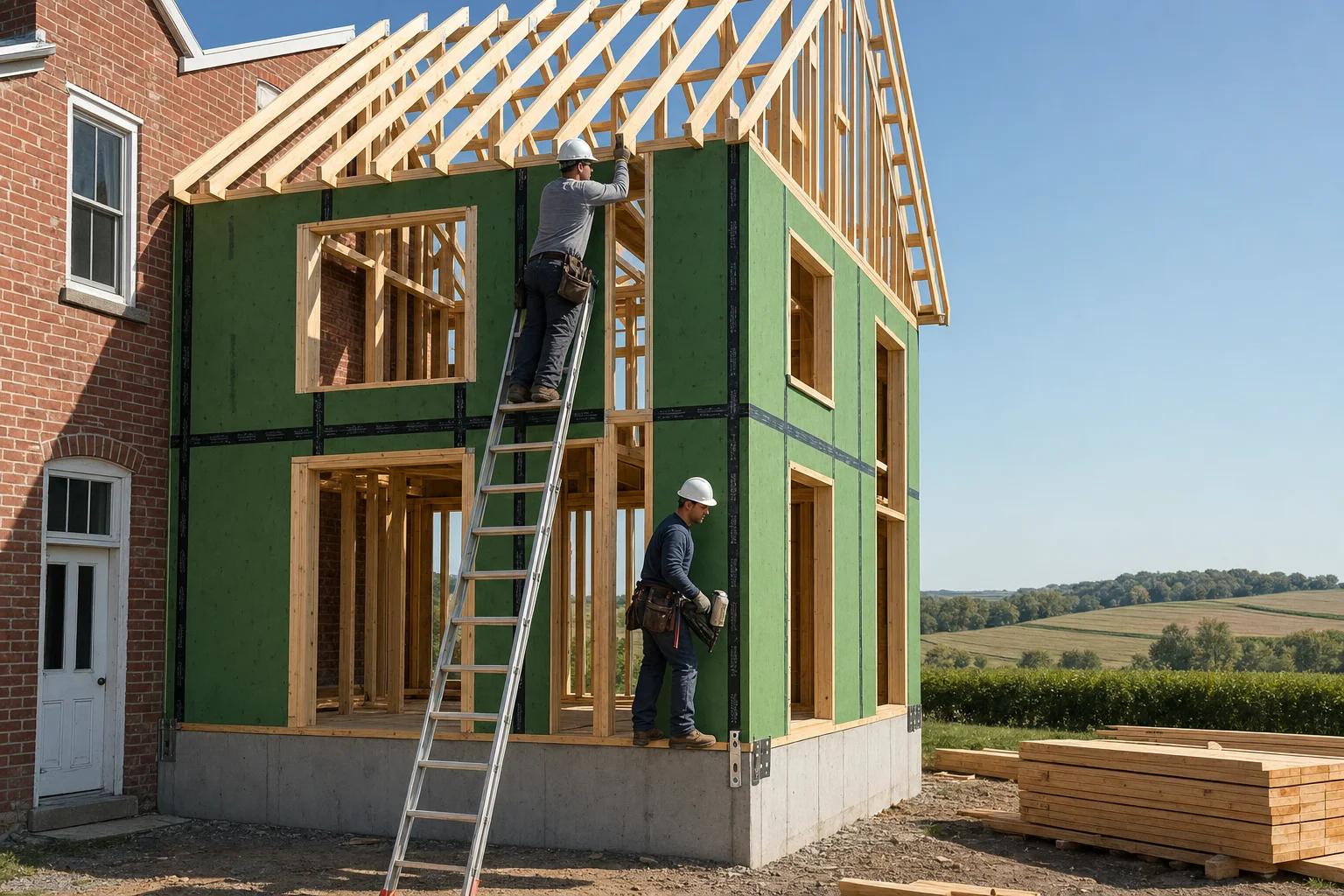
Before you plan an addition, a basement project or a new home in Pennsylvania, check what is under and around the lot. State agencies publish tools and reports on four ground conditions: abandoned coal mines, sinkholes in limestone areas, landslides on steep slopes and radon gas. Add a flood map check and you have a short list to work through before design starts.
Mine subsidence
The Pennsylvania Department of Environmental Protection says there are coal deposits and abandoned mines in 43 of the state's 67 counties. When old mines collapse, foundations can crack and tilt out of level, walls, floors and ceilings can crack, and doors and windows can jam.
- Look up the property in DEP's MSI Risk mapping application. It shows mining conditions by address, coordinates or municipality.
- Ask your insurance agent about Mine Subsidence Insurance. DEP notes that homeowner's insurance usually does not cover damage from the collapse of underground coal and clay mines.
- Share what you find with your designer and builder before foundation plans are drawn.
Sinkholes in limestone areas
The Department of Conservation and Natural Resources explains that karst is common where limestone and dolostone bedrock lies under the surface. Human activity can speed up sinkhole formation, and karst systems are sensitive to land-use changes. The Pennsylvania Geological Survey has published county reports that map carbonate bedrock areas with a history of sinkholes, including reports for Lancaster and Lehigh counties.
Landslides on steep lots
DCNR reports that southwestern Pennsylvania has by far the highest concentration of landslides in the state. Backyard landslides are common in the Pittsburgh area and are usually repaired incompletely or not at all. Many slides happen in loose soil and old landslide debris on steep slopes. If you plan to build into or near a hillside, raise slope stability early in design.
Radon
DEP reports that about 40 percent of Pennsylvania homes tested have radon above the EPA action guideline of 4 pCi/L. Testing is the only way to know if a home has elevated radon. Test before you finish a basement or add living space at or below grade, so the result can shape the plan.
Flood zones
FEMA's Flood Map Service Center is the official public source for flood hazard maps. You can search it by address. Check it before you plan any addition or lower-level work.
A simple pre-design checklist
- Search the address in DEP's MSI Risk map.
- Check whether the lot sits on carbonate bedrock using the Geological Survey's county reports.
- Note any steep slopes or signs of past ground movement.
- Test for radon.
- Look up the address on the FEMA flood map.
- Bring the results to your first design meeting, and to the local code office when you apply for a permit.
Sources (8)
- Pennsylvania Department of Environmental Protection · checked 2026-09-24
- Pennsylvania Department of Environmental Protection · checked 2026-09-24
- Pennsylvania Department of Conservation and Natural Resources · checked 2026-09-24
- Pennsylvania Geological Survey (DCNR) · checked 2026-09-24
- Pennsylvania Geological Survey (DCNR) · checked 2026-09-24
- Pennsylvania Department of Conservation and Natural Resources · checked 2026-09-24
- Pennsylvania Department of Environmental Protection · checked 2026-09-24
- Federal Emergency Management Agency · checked 2026-09-24