
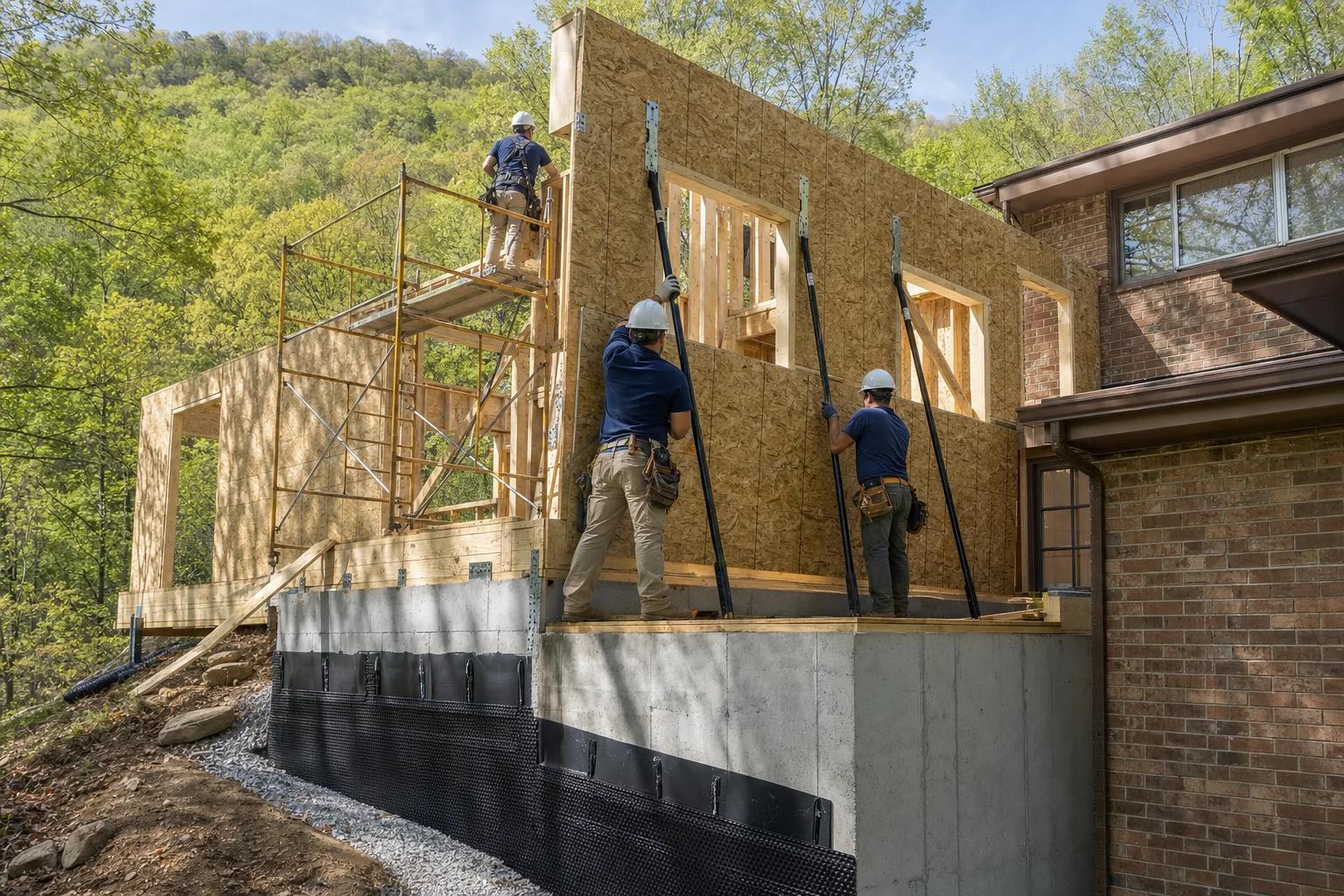
In Tennessee, your building permit usually comes from one of two places. Larger cities run their own building departments. Where there is no local program, the State Fire Marshal's Office runs a residential permit program, unless the city or county has opted out of state residential codes. The rules are not the same, so start by finding out which one covers your address.
The state residential permit program
- It covers one- and two-family homes and townhouses in areas that have not been exempted for local code enforcement or opted out of state residential codes.
- It applies to new construction and to additions over 30 square feet.
- Renovations do not need a state permit, and detached structures not used for living space do not either.
- Permits are bought online through the state's CORE system or through local issuing agents.
- State-contracted inspectors check the foundation, the framing and rough-in, and the finished work.
Cities with their own building departments
The State Fire Marshal's Office approves some local governments as exempt jurisdictions for buildings that would otherwise need state plan review and inspection. They include Nashville and Davidson County, Memphis, Knoxville, Chattanooga, Clarksville, Murfreesboro, Jackson and Johnson City. These cities do their own plan review and inspections. They must adopt codes within seven years of the newest published edition, so the edition varies. Metro Nashville lists the 2024 International Codes, while Chattanooga enforces the 2018 International Building and Residential Codes.
City rules can cover more work
- Metro Nashville requires permits for siding and roofing, new decks and garages, storage buildings of 100 square feet or more, and turning a garage, basement or attic into living space.
- Nashville treats painting, floor finishing and roof repairs up to 33 percent of the roof area as normal maintenance.
- Clarksville issues permits for renovations as well as new construction and additions.
- In Clarksville, homeowners may permit work on their own primary home, but not plumbing or mechanical and gas work.
Owner-builders
Under the state program, an owner may build one home every two years for their own use without a contractor license, as long as it is not for sale, lease or rent. In Nashville, an owner who lives in or will live in a single-family home may get a self permit and takes on responsibility for code compliance.
How to find your permit path
- Check whether your city or county has its own building department.
- If it does, ask which code editions it uses and whether your scope of work needs a permit.
- If it does not, check whether your project falls under the state residential program.
- Look up any contractor's license at verify.tn.gov before you hire them.
Sources (7)
- Tennessee Department of Commerce & Insurance, State Fire Marshal's Office · checked 2026-09-24
- Tennessee Department of Commerce & Insurance, State Fire Marshal's Office · checked 2026-09-24
- Tennessee Department of Commerce & Insurance, State Fire Marshal's Office · checked 2026-09-24
- Metro Nashville Department of Codes & Building Safety · checked 2026-09-24
- City of Chattanooga Land Development Office · checked 2026-09-24
- Metro Nashville Department of Codes & Building Safety · checked 2026-09-24
- City of Clarksville Building & Codes Department · checked 2026-09-24