
Arizona Construction Pros
Bathroom Remodeling in Arizona
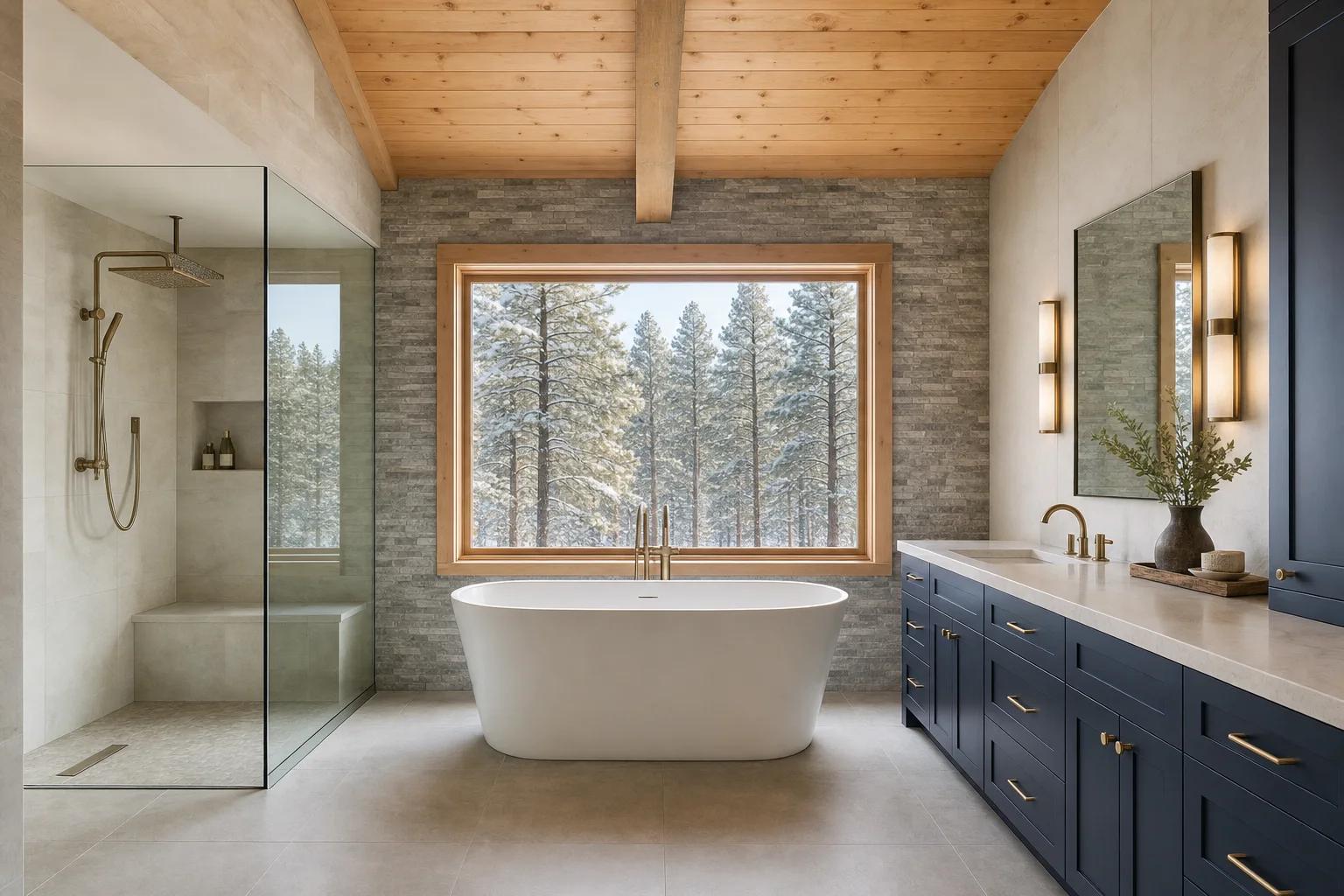
Arizona context
Planning bathroom remodeling in Arizona
Codes are adopted locally, so editions differ by city
Arizona law lets cities adopt building codes by reference and lets counties that have adopted zoning do the same for unincorporated areas, so the rules depend on the address. Recent adoptions show the spread. Phoenix has enforced its 2024 building code since August 1, 2025, Chandler required 2024 editions for plans submitted on or after July 1, 2025, Mesa began applying them on January 8, 2026, and Tucson's building and residential codes took effect January 1, 2026. Scottsdale's city page still lists 2021 editions, and Flagstaff's page still lists its 2019 adopted codes, which amend the 2018 editions, as current, with the 2024 codes described as upcoming.
No statewide energy code, and climate zones from 2B to 5B
The U.S. Department of Energy lists no statewide residential or commercial energy code for Arizona, so energy rules come from each jurisdiction. Under the 2021 IECC, county climate zones run from 2B (hot-dry) in Maricopa, Pima, Pinal, Yuma and La Paz counties, through 3B in Mohave, Cochise, Graham, Greenlee and Santa Cruz, and 4B in Yavapai and Gila, to 5B (cold) in Coconino, Navajo and Apache. Phoenix adopted the 2024 IECC with its 2024 code, while Prescott's adoption document points its energy chapter to the 2012 IECC, so the edition for your city sets insulation, window and air-sealing requirements.
Extreme heat and monsoon storms
Phoenix recorded 122 days at or above 100 degrees and 37 days at or above 110 degrees in 2025, with a high of 118. Arizona's monsoon season runs from June 15 to September 30, and thunderstorm wind gusts in the Southwest almost always exceed 40 mph and can pass 100 mph, along with dust storms and flash flooding. The state's Workplace Heat Safety Task Force recommends access to water, shade and rest, acclimatization and heat safety training, and those practices belong in any summer roofing or exterior schedule.
Sources (16)
- Arizona Legislature, A.R.S. 9-802 (municipal adoption of codes by reference) · checked 2026-09-25
- Arizona Legislature, A.R.S. 11-861 (county building codes) · checked 2026-09-25
- U.S. Department of Energy, Building Energy Codes Program · checked 2026-09-25
- Pacific Northwest National Laboratory for the U.S. Department of Energy (PNNL-33270) · checked 2026-09-25
- National Weather Service Phoenix · checked 2026-09-25
- National Weather Service Phoenix · checked 2026-09-25
- Arizona Department of Water Resources · checked 2026-09-25
- Office of the Arizona Governor · checked 2026-09-25
- City of Phoenix Planning and Development Department · checked 2026-09-25
- City of Tucson Planning and Development Services · checked 2026-09-25
- City of Mesa Development Services · checked 2026-09-25
- City of Chandler Development Services · checked 2026-09-25
- City of Scottsdale · checked 2026-09-25
- City of Flagstaff Building Safety and Code Compliance · checked 2026-09-25
- City of Prescott, 2024 code adoption (Exhibit A) · checked 2026-09-25
- City of Flagstaff Building Safety and Code Compliance · checked 2026-09-25
Permits
Bathroom work that moves or adds plumbing, adds electrical circuits or fixtures, changes ventilation or alters walls commonly needs a permit and inspections. Replacing a vanity or toilet in the same location may not. Rules differ by jurisdiction, so the local building department confirms what is required for your project.
Contractor licensing
Arizona Registrar of Contractors (ROC)
Arizona licenses contractors through the Registrar of Contractors, which issues residential, commercial and dual licenses. Residential work is construction within residential property lines on houses, townhouses, condominiums and cooperative units; commercial work is construction outside residential property lines, and a dual license covers both. One exemption covers casual or minor work with a total contract price under $1,000 that is not part of a larger operation and does not require a local building permit, and unlicensed people who advertise must say they are not licensed contractors. A license requires a qualifying party with at least four years of practical or management trade experience (technical training can replace up to two of those years), a passed written exam and a surety bond or cash deposit; the statute sets general residential bonds between $5,000 and $15,000, with commercial amounts that scale with annual volume. The registrar also administers the Residential Contractors' Recovery Fund, which benefits eligible claimants, including owner-occupants, damaged by a licensed residential contractor's violations. Whoever you hire, confirm the license status and class with the ROC Contractor Search before signing, and get a written contract, which state law requires to contain specific information on residential jobs over $1,000.
Check a contractor’s status (opens the official Arizona site in a new tab)Building permits
Permits in Arizona
Each Arizona city enforces the building codes it has adopted by reference, and counties that have adopted zoning can adopt codes for unincorporated areas, so editions and exemptions differ from place to place. Phoenix asks for the contractor's license number, if applicable, on applications and requires historic area approval before submittal; Tucson takes applications through Tucson Development Center Online and Flagstaff through its Citizen Access Portal; Chandler advises getting association approval first. Historic districts, wildland-urban interface rules and drainage rules can add review on top of the building permit. Permit needs vary by jurisdiction and project, so they are confirmed for your address during planning.
Sources (14)
- Arizona Legislature, A.R.S. 32-1101 (definitions) · checked 2026-09-25
- Arizona Legislature, A.R.S. 32-1121 (licensing exemptions) · checked 2026-09-25
- Arizona Legislature, A.R.S. 32-1122 (qualifications for license) · checked 2026-09-25
- Arizona Legislature, A.R.S. 32-1132 (residential contractors' recovery fund) · checked 2026-09-25
- Arizona Legislature, A.R.S. 32-1152 (license bonds) · checked 2026-09-25
- Arizona Attorney General's Office · checked 2026-09-25
- Arizona Legislature, A.R.S. 9-802 (municipal adoption of codes by reference) · checked 2026-09-25
- Arizona Legislature, A.R.S. 11-861 (county building codes) · checked 2026-09-25
- City of Phoenix Planning and Development Department, residential permit guide (revision dated 2/20) · checked 2026-09-25
- City of Tucson Planning and Development Services · checked 2026-09-25
- City of Tucson Planning and Development Services · checked 2026-09-25
- City of Chandler Development Services, Homeowner's Building Permit Manual (April 2026) · checked 2026-09-25
- City of Flagstaff Building Safety and Code Compliance · checked 2026-09-25
- City of Flagstaff Fire Department · checked 2026-09-25
What’s included
Bathroom Remodeling in Arizona: scope and options
- Demolition down to studs and subfloor where the condition calls for it
- Shower and tub installation, including tub-to-shower conversions
- Waterproofing behind tile in showers and other wet areas
- Floor, wall and shower tile installation
- Vanity, sink, toilet and faucet installation
- Exhaust fan installation or replacement, vented to the outdoors
- Plumbing and electrical updates coordinated with licensed trades where required
- Wall blocking for grab bars, plus lighting, mirrors and accessories
Common options
- Tub, shower or both
- Keep a tub for bathing, convert to a walk-in shower for easier access, or install a tub and shower combination.
- Shower base
- A prefabricated pan installs quickly and simply. A tiled base allows custom sizes and low or curbless entries but involves more steps.
- Wall surfaces
- Tile, solid-surface panels or acrylic surrounds. Panels have few grout lines to clean, while tile offers more design choice.
- Vanity style
- Freestanding, wall-hung or built-in, with one or two sinks, sized to the storage you need and the space around it.
- Accessibility features
- Grab bars, a handheld shower, a bench, lever handles and a comfort-height toilet can be installed now or planned with wall blocking for later.
What this service does not cover
- Remediation of widespread mold, which is handled by remediation specialists
- Asbestos or lead-based paint abatement, which is handled by certified specialists
- Replacing main water or sewer lines outside the bathroom
- Repairs to water damage in rooms below the bathroom, unless added to the scope in writing
Budget planning
What affects cost
Layout changes
Moving the toilet, shower or drains means more plumbing and floor work than keeping fixtures in place.
Shower type
Custom tiled showers with niches, benches or curbless entries take more labor than prefabricated units.
Tile selection
Tile size, material, pattern and how much of the walls are covered all affect labor and materials.
Subfloor and framing condition
Water-damaged subfloor or framing has to be repaired before new finishes can go in.
Ventilation
Adding or rerouting an exhaust fan so it vents outdoors can require work through walls, ceilings or the attic.
Fixtures and glass
Shower valve types, specialty fixtures and custom glass doors vary widely.
Access and staging
Tight rooms, upper floors and homes with only one bathroom affect how the work is sequenced.
Scheduling
What affects the schedule
- Whether this is the only bathroom in the home
- Custom shower glass, which is measured after tile is complete
- Special-order vanities, tile and fixtures
- Inspection timing for plumbing and electrical rough-in
- Drying and curing time for waterproofing, mortar and grout
- Water damage found after demolition
How to prepare
- If this is your only bathroom, arrange another place to shower during the key stages
- Remove toiletries, towels, rugs and anything stored in the vanity
- Choose tile, vanity and fixtures early so they arrive before demolition
- Note any current leaks, ceiling stains in the room below, or soft spots in the floor
- Think about future needs, such as grab bars or a step-free shower
Process
How Bathroom Remodeling Projects Work
- 1
Consult
We look at the room, check for signs of leaks and soft spots in the floor, and talk through who uses the bathroom and how. Storage and accessibility needs come up here.
- 2
Plan
We settle the layout, tub or shower, tile, fixtures and ventilation, and write down the scope. Fixtures and tile are selected and ordered before demolition so the room is not left open waiting on materials.
- 3
Build
Demolition, plumbing and electrical rough-in, and inspections come first. Waterproofing is installed and checked before tile covers it, followed by fixtures, glass and trim.
- 4
Enjoy
A final walkthrough covers how fixtures and the fan work and how to care for grout, stone and glass. Punch-list items are completed before closeout.
Service areas
Where we plan bathroom remodeling projects in Arizona
Other communities
Related services in Arizona
Questions
Bathroom Remodeling FAQs
Can I convert my tub to a walk-in shower?
In most bathrooms, yes. The drain location, floor framing and wall conditions decide how simple it is. A low or curbless entry takes more floor work than a shower with a standard curb.
Why does waterproofing matter if tile resists water?
Grout and many tile materials let some water pass through over time. A waterproofing layer behind the tile keeps that water out of the walls and subfloor, where it would otherwise cause rot and mold.
Do I need a bathroom exhaust fan?
A fan that vents outdoors removes moisture that would otherwise collect on walls, ceilings and inside cabinets, leading to peeling paint and mold. Whether a fan is required depends on local code and whether the room has a window that opens.
What if this is my only bathroom?
The work can be sequenced to limit how long the toilet and sink are out of service, but there will be stretches without a working shower. Decide where you will shower during those stages before work starts.
Should I choose a prefabricated shower or tile?
Prefabricated units install faster and have few seams to clean. Tile gives more size, shape and design choices and allows niches and benches. Both perform well when installed correctly.
Can grab bars be added later?
Yes, if solid blocking is installed inside the walls during the remodel. Adding blocking while walls are open is simple compared with cutting into finished tile later.
Ready to Plan Bathroom Remodeling in Arizona?
Share the scope and the address. We'll confirm availability and follow up to talk through options and next steps.