
Florida Construction Pros
Bathroom Remodeling in Florida
Florida context
Planning bathroom remodeling in Florida
One statewide building code, updated every three years
Florida uses its own Florida Building Code. It applies statewide without each local government having to adopt it. The Florida Building Commission updates it every three years after reviewing the latest International Code Council codes and the National Electrical Code. The 8th Edition (2023) took effect on December 31, 2023. A city or county can strengthen the code with local technical amendments only after an advertised public hearing and a finding of local need, and those amendments last only until the next edition is adopted.
Energy code and climate zones 1 and 2
Florida's residential energy code is based on the 2021 IECC with state amendments and took effect on December 31, 2023. All of Florida falls in IECC climate zones 1 and 2. A study published by the Florida Building Commission uses Miami for zone 1 and Tampa and Jacksonville for zone 2. New homes must be tested for air leakage, with a limit of seven air changes per hour at 50 pascals in both zones. In zone 2, the prescriptive path does not allow electric resistance heat as the primary heating system, and complete equipment replacements face a similar ban, though many small projects can be exempted.
Hurricane season, wind rules and product approvals
The Atlantic hurricane season runs from June 1 to November 30. The peak is around September 10, and most activity falls between mid-August and mid-October. Miami-Dade County is in the High-Velocity Hurricane Zone, where doors, windows, shutters, roofing, truss connectors and prefabricated buildings need county product approval. State law also has a partial-roof rule: if a roof was built, repaired or replaced under the 2007 Florida Building Code or later, and 25 percent or more of it is being repaired, replaced or recovered, only that portion has to meet the current code.
Sources (7)
- Florida Legislature, Florida Statutes s. 553.73 (2026) · checked 2026-09-24
- Florida Building Commission (floridabuilding.org) · checked 2026-09-24
- U.S. Department of Energy, Building Energy Codes Program · checked 2026-09-24
- Florida Solar Energy Center report published by the Florida Building Commission · checked 2026-09-24
- Florida Legislature, Florida Statutes s. 553.844 (2026) · checked 2026-09-24
- NOAA National Hurricane Center · checked 2026-09-24
- Miami-Dade County news release, April 30, 2025 · checked 2026-09-24
Permits
Bathroom work that moves or adds plumbing, adds electrical circuits or fixtures, changes ventilation or alters walls commonly needs a permit and inspections. Replacing a vanity or toilet in the same location may not. Rules differ by jurisdiction, so the local building department confirms what is required for your project.
Contractor licensing
Florida Department of Business and Professional Regulation (DBPR), Construction Industry Licensing Board
Florida licenses construction contractors at the state level through the Construction Industry Licensing Board. A certified license lets a contractor work anywhere in Florida. A registered license is limited to the local jurisdictions where the contractor met competency requirements. License categories include general, building and residential contractors, plus trades such as roofing, plumbing, air-conditioning, mechanical and pool contractors. A residential contractor is limited to one-, two- and three-family homes with no more than two habitable stories above at most one uninhabitable story. Electrical contractors are licensed by a separate state board. A narrow exemption covers minor jobs under $2,500 in total, but not work that is part of a larger job or split up to avoid licensing. Owners who personally supervise work on their own one- or two-family home for their own use can act as owner-builders after signing a disclosure statement; selling or leasing the home within a year of completion creates a presumption that the work was done for sale or lease. Before hiring any contractor, ask for the license number and check it on the DBPR license search.
Check a contractor’s status (opens the official Florida site in a new tab)Building permits
Permits in Florida
Florida law requires a permit to build, alter, repair or demolish a building unless the law provides an exemption. Permits are issued by the building department of the city or county where the property is located, such as the City of Miami Building Department or Tampa's Construction Services Division. These offices enforce the statewide Florida Building Code and any local technical amendments. Since July 1, 2026, owners of single-family homes, or their contractors, can skip the permit for work valued under $7,500 by filing a written request with a contract or other proof of the work's nature and value. The exemption does not cover electrical, plumbing, structural, mechanical or gas work, or any property partly or fully in a flood hazard area, and a project cannot be split up to fit under the limit. Some departments, such as St. Petersburg's, treat window and door replacement, roofing, soffit, fascia and siding as structural work. Many jobs also need a notice of commencement recorded and posted on site before the first inspection. Permit needs are confirmed for your address during planning.
Sources (12)
- Florida Legislature, Florida Statutes s. 553.73 (2026) · checked 2026-09-24
- Florida Legislature, Florida Statutes s. 489.103 (2026) · checked 2026-09-24
- Florida Legislature, Florida Statutes s. 489.105 · checked 2026-09-24
- Florida DBPR, Construction Industry Licensing Board · checked 2026-09-24
- Florida DBPR, Electrical Contractors' Licensing Board · checked 2026-09-24
- Florida DBPR Online Services, License Search · checked 2026-09-24
- Florida Legislature, Florida Statutes s. 713.13 (2026) · checked 2026-09-24
- The Florida Senate, CS/CS/HB 803 (2026) bill history · checked 2026-09-24
- Florida Legislature, enrolled text of CS/CS/HB 803 (2026), Chapter 2026-63, amending s. 553.79 and s. 720.3035, Florida Statutes · checked 2026-09-24
- City of Miami Building Department · checked 2026-09-24
- City of Tampa Construction Services Division · checked 2026-09-24
- City of St. Petersburg Construction Services and Permitting Division · checked 2026-09-24
What’s included
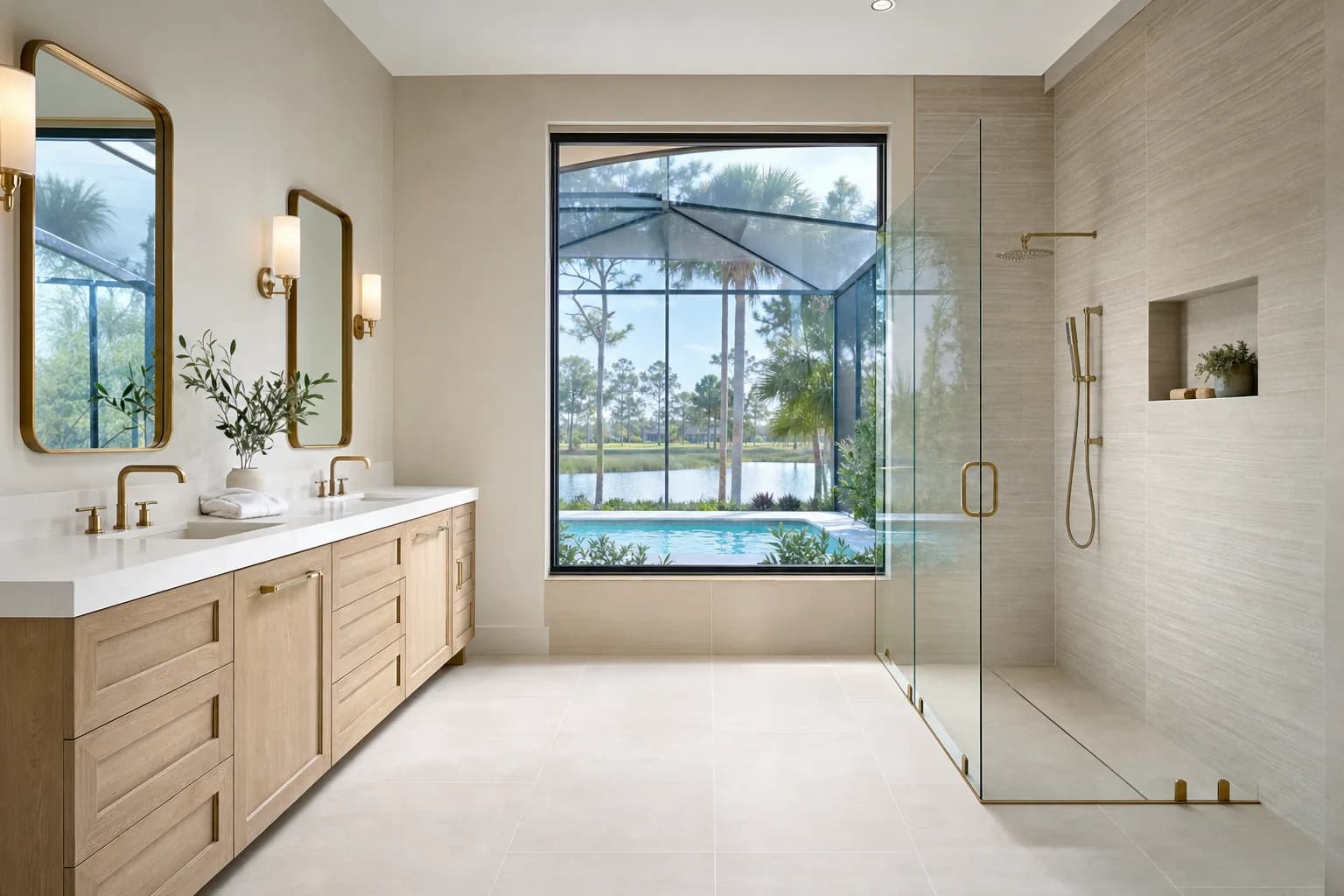
Bathroom Remodeling in Florida: scope and options
- Demolition down to studs and subfloor where the condition calls for it
- Shower and tub installation, including tub-to-shower conversions
- Waterproofing behind tile in showers and other wet areas
- Floor, wall and shower tile installation
- Vanity, sink, toilet and faucet installation
- Exhaust fan installation or replacement, vented to the outdoors
- Plumbing and electrical updates coordinated with licensed trades where required
- Wall blocking for grab bars, plus lighting, mirrors and accessories
Common options
- Tub, shower or both
- Keep a tub for bathing, convert to a walk-in shower for easier access, or install a tub and shower combination.
- Shower base
- A prefabricated pan installs quickly and simply. A tiled base allows custom sizes and low or curbless entries but involves more steps.
- Wall surfaces
- Tile, solid-surface panels or acrylic surrounds. Panels have few grout lines to clean, while tile offers more design choice.
- Vanity style
- Freestanding, wall-hung or built-in, with one or two sinks, sized to the storage you need and the space around it.
- Accessibility features
- Grab bars, a handheld shower, a bench, lever handles and a comfort-height toilet can be installed now or planned with wall blocking for later.
What this service does not cover
- Remediation of widespread mold, which is handled by remediation specialists
- Asbestos or lead-based paint abatement, which is handled by certified specialists
- Replacing main water or sewer lines outside the bathroom
- Repairs to water damage in rooms below the bathroom, unless added to the scope in writing
Budget planning
What affects cost
Layout changes
Moving the toilet, shower or drains means more plumbing and floor work than keeping fixtures in place.
Shower type
Custom tiled showers with niches, benches or curbless entries take more labor than prefabricated units.
Tile selection
Tile size, material, pattern and how much of the walls are covered all affect labor and materials.
Subfloor and framing condition
Water-damaged subfloor or framing has to be repaired before new finishes can go in.
Ventilation
Adding or rerouting an exhaust fan so it vents outdoors can require work through walls, ceilings or the attic.
Fixtures and glass
Shower valve types, specialty fixtures and custom glass doors vary widely.
Access and staging
Tight rooms, upper floors and homes with only one bathroom affect how the work is sequenced.
Scheduling
What affects the schedule
- Whether this is the only bathroom in the home
- Custom shower glass, which is measured after tile is complete
- Special-order vanities, tile and fixtures
- Inspection timing for plumbing and electrical rough-in
- Drying and curing time for waterproofing, mortar and grout
- Water damage found after demolition
How to prepare
- If this is your only bathroom, arrange another place to shower during the key stages
- Remove toiletries, towels, rugs and anything stored in the vanity
- Choose tile, vanity and fixtures early so they arrive before demolition
- Note any current leaks, ceiling stains in the room below, or soft spots in the floor
- Think about future needs, such as grab bars or a step-free shower
Process
How Bathroom Remodeling Projects Work
- 1
Consult
We look at the room, check for signs of leaks and soft spots in the floor, and talk through who uses the bathroom and how. Storage and accessibility needs come up here.
- 2
Plan
We settle the layout, tub or shower, tile, fixtures and ventilation, and write down the scope. Fixtures and tile are selected and ordered before demolition so the room is not left open waiting on materials.
- 3
Build
Demolition, plumbing and electrical rough-in, and inspections come first. Waterproofing is installed and checked before tile covers it, followed by fixtures, glass and trim.
- 4
Enjoy
A final walkthrough covers how fixtures and the fan work and how to care for grout, stone and glass. Punch-list items are completed before closeout.
Service areas
Where we plan bathroom remodeling projects in Florida
Other communities
Related services in Florida
Questions
Bathroom Remodeling FAQs
Can I convert my tub to a walk-in shower?
In most bathrooms, yes. The drain location, floor framing and wall conditions decide how simple it is. A low or curbless entry takes more floor work than a shower with a standard curb.
Why does waterproofing matter if tile resists water?
Grout and many tile materials let some water pass through over time. A waterproofing layer behind the tile keeps that water out of the walls and subfloor, where it would otherwise cause rot and mold.
Do I need a bathroom exhaust fan?
A fan that vents outdoors removes moisture that would otherwise collect on walls, ceilings and inside cabinets, leading to peeling paint and mold. Whether a fan is required depends on local code and whether the room has a window that opens.
What if this is my only bathroom?
The work can be sequenced to limit how long the toilet and sink are out of service, but there will be stretches without a working shower. Decide where you will shower during those stages before work starts.
Should I choose a prefabricated shower or tile?
Prefabricated units install faster and have few seams to clean. Tile gives more size, shape and design choices and allows niches and benches. Both perform well when installed correctly.
Can grab bars be added later?
Yes, if solid blocking is installed inside the walls during the remodel. Adding blocking while walls are open is simple compared with cutting into finished tile later.
Ready to Plan Bathroom Remodeling in Florida?
Share the scope and the address. We'll confirm availability and follow up to talk through options and next steps.